
Article: Thermory vs. Cedar Sauna Wood: What Buyers Need to Know | Sauna Friend

Thermory vs. Cedar Sauna Wood: What Buyers Need to Know | Sauna Friend
The Unsexy Variable That Changes Everything
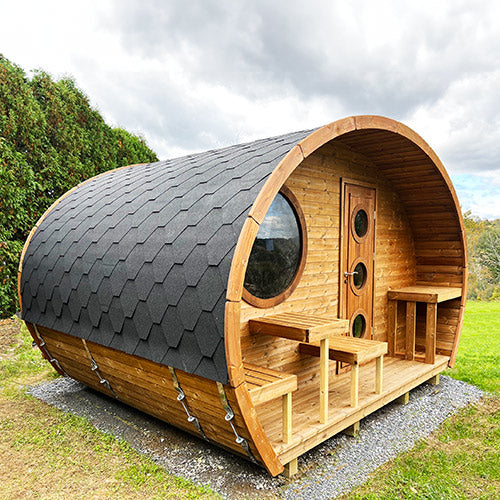
A barrel sauna sitting on your deck is exposed to everything: UV radiation, rain, snow, freeze-thaw cycles, humidity changes, temperature swings of 60+ degrees between interior and exterior surfaces. Wood that isn't built for this kind of stress will respond exactly how you'd expect — it warps, cracks, swells, and contracts. Doors stop seating properly. Gaps appear in the stave seams. The sauna that looked stunning in the product photos starts to look weathered in all the wrong ways within a few seasons.
The wood species and modification process determine how your sauna responds to all of that. And the difference between a premium wood and a cheap alternative isn't subtle — it's the difference between a 10-year maintenance problem and a 30-year asset.
What Thermory Actually Is
Thermory isn't a brand name for a type of wood — it's a proprietary thermal modification process applied to select European timber. The process works like this: solid wood is subjected to extremely high heat (around 200°C / 392°F) in a steam environment, with no chemicals involved at any stage.
At those temperatures, the cellular structure of the wood permanently changes. The sugars and starches that normally attract moisture, fungi, and insects are effectively denatured. What's left is a fundamentally different material — one that looks like wood, feels like wood, but behaves far better than wood in demanding outdoor conditions.
Here's what that means in practical terms:
Class 1 Durability Rating
This is the highest durability classification available for wood under European standards (EN 350). It means Thermory is rated for 25+ years of outdoor use without protective treatment. For context, western red cedar — the most common sauna wood alternative — carries a Class 2–3 rating, translating to roughly 10–15 years of outdoor durability.
No Chemical Treatment — Ever
Because the modification is purely thermal, there are no preservatives, resins, or chemical coatings involved. The wood is safe, it doesn't off-gas anything into your sauna environment, and it meets the highest standards for health-conscious use. For anyone building a sauna as a wellness practice, this matters.
Dimensional Stability
Thermory's modified cell structure dramatically reduces moisture absorption and release — the primary cause of warping, cracking, and seasonal movement in standard wood. Your Thermory sauna staves hold their shape. Your door fits in January the same way it did in August. The seams stay tight. The structure stays true.
1.65" Barrel Staves
Thermory barrel saunas use thick, purpose-dimensioned staves that contribute to both insulation and structural integrity. This isn't dimensional lumber dressed up to look like a sauna — it's purpose-built material.
It Gets Better With Time
Left to weather naturally, Thermory transitions from its warm initial tone to a refined silver-gray patina over time. This isn't degradation — it's a natural aging process that many owners consider one of the most beautiful features of the sauna. No staining, no painting, no annual maintenance required.
The Problem With Most "Cedar" Saunas
The majority of entry-to-mid price traditional saunas on the market are built with cedar or "natural wood" sourced from manufacturing operations in China. The price points are attractive. The product photos look good. And for the first year or two, they often perform reasonably well.
But there's a structural problem that most buyers don't know about: under USDA APHIS (Animal and Plant Health Inspection Service) regulations, all manufactured wood products imported from China must be heat-treated or chemically treated before entering the United States. This often means fumigation — historically with methyl bromide, a broad-spectrum pesticide — to prevent the introduction of invasive insects and plant diseases.
The fumigation process doesn't improve the wood. It doesn't prevent moisture absorption, dimensional movement, or long-term degradation. It's a regulatory compliance measure, not a quality enhancement.
And the raw material itself — processed cedar from Chinese mills — often lacks the density, drying consistency, and natural durability of wood sourced from slower-growing northern European or North American forests. The combination of lower-quality raw material and the stresses of import processing contributes to the warping, cracking, and door-seating problems that are unfortunately common in this product category.
I've assembled enough of these saunas firsthand to tell you: the issues aren't one-off defects. They're predictable outcomes of the material and manufacturing choices made at the beginning of the supply chain.
How Other Brands Compare
Not every sauna is built the same way, and it's worth understanding the landscape.
SaunaLife uses thermally modified Nordic spruce sourced and milled in Northern Europe — the same type of heat-and-steam treated wood as Thermory. SaunaLife models include asphalt shingles (a real roof, not a rain jacket — important for HOA communities) and a Wi-Fi-controlled LED lighting kit standard. A strong mid-tier option for buyers who want thermally modified wood at a slightly lower price point with some convenient extras included.
Auroom is a premium Estonian sauna manufacturer and a member of the Thermory Group — meaning their saunas are built directly with Thermory's own thermally modified timber. Auroom brings an architectural design sensibility to the category: furniture-quality interiors, invisible fasteners, full tempered glass fronts, dimmable LED lighting, and PVC subflooring are all standard. Every sauna is fully assembled and inspected at their factory in Tartu, Estonia before shipment. For buyers who want the finest materials and the finest craftsmanship in a contemporary design, Auroom is in a class of its own.
Almost Heaven uses Western red cedar and Nordic spruce — naturally beautiful and aromatic, but not thermally modified. They're built at a more accessible price point, equipped with Harvia heaters (a globally respected brand), and feature a unique rotocast plastic cradle system that elevates the barrel off the ground to prevent ground-contact moisture damage. A solid choice for buyers who want a traditional cedar sauna experience with thoughtful construction at a lower entry price — with the understanding that you're trading some long-term durability for upfront cost savings.
The Real Cost Comparison
A Thermory sauna costs more upfront than a Chinese cedar alternative. That's simply true.
But here's what that comparison actually looks like over time: a cedar sauna at $3,500 that requires significant maintenance, develops structural issues in years 3–5, and needs to be replaced in year 10 is a $3,500+ investment with a poor outcome. A Thermory sauna at $6,000 that performs beautifully for 30+ years — with no maintenance requirements, no warping, no door problems — is a dramatically better value proposition over any reasonable time horizon.
More to the point: a sauna that looks and functions the way it should every time you use it is the one you'll actually use. The whole point of this purchase is to build a health practice. The best sauna is the one that earns a permanent place in your daily life.
Our Approach at Sauna Friend
We carry Thermory as our flagship traditional sauna line because it's the wood we would put in our own backyards. We also carry SaunaLife, Auroom, and Almost Heaven for buyers with different aesthetic preferences, price points, or footprint requirements — and we're transparent about what each material means for long-term ownership.
When you request pricing through Sauna Friend, you get private member access to our curated lineup — along with someone who can help you think through the decision based on your goals, not a commission.
If you're ready to look at pricing or have questions about which sauna fits your space, reach us at support@saunafriend.com or 720-780-4400.
David Drimmel is the Founding Director of the Origin Institute, a non-profit institute for Traditional Chinese Medicine Arts, Qigong, and Holistic Studies. He operates Sauna Friend Sanctuary Supply as part of the Bioharmony Collective, a faith-based wellness ministry dedicated to education, community, and the cultivation of lifelong health.


Leave a comment
This site is protected by hCaptcha and the hCaptcha Privacy Policy and Terms of Service apply.